

By Wayne Gillam / UW ECE News
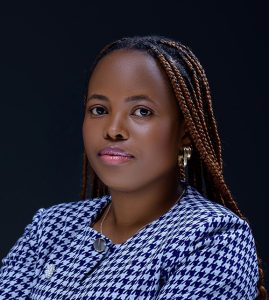
UW ECE doctoral student Eliane Nirere has received a 2026 fellowship award from the Sarala Vadari Endowed Fund in Electrical & Computer Engineering. The award honors her academic achievements and research aimed at bringing electricity and renewable energy to remote, underserved communities in Sub-Saharan Africa. Photo by Digitec Studios in Rwanda.
This academic quarter, UW ECE doctoral student Eliane Nirere received a 2026 fellowship award from the Sarala Vadari Endowed Fund in Electrical & Computer Engineering — a fund established at UW ECE to foster advanced education in Power and Energy Systems. Each year, the fund recognizes an exceptional UW ECE graduate student in this field of study. This year’s fellowship award honors Nirere’s academic achievements and her research aimed at bringing electricity and renewable energy to remote, underserved communities in Sub-Saharan Africa.
“This fellowship means a lot to me, and it came to the right person at the right time. It has helped me to extend my working hours and be able to devote more time to my research,” Nirere said. “The funding from the Vadari fellowship is helping me to achieve more, and it is contributing to research that is making change for people who need it.”
A personal mission shaped by experience
Nirere was born and raised in Rwanda, where she saw firsthand how a lack of electricity affects education, health, and economic opportunity. As a child, she wanted to help address the problem, even though she did not yet know what the solution could be. In school, she excelled in math and physics. So, at the university level, she decided to major in engineering, hoping to work in one of the local utilities on the technical side of electricity generation.
“To achieve a transition to renewable energy, we will need decentralized systems, such as mini-grids, to electrify rural areas and also supplement and integrate renewable energies in the larger grids. It’s important to note that these systems, which we optimize or develop as engineers, need to be usable and benefit the communities they serve. To achieve that, we need to include the community perspective in our planning.” — UW ECE doctoral student Eliane Nirere
In 2020, she received her bachelor’s degree in mechanical and energy engineering from the University of Rwanda. She went on to pursue graduate studies at Carnegie Mellon University Africa, where, in 2022, she graduated with a master’s degree in electrical and computer engineering with a concentration in power and energy systems.
“During my graduate studies, I was exposed to renewable energy research and how it could help bring electricity to people in rural and remote areas,” she said. “I was really moved by that experience and inspired and eager to join other people involved in this work.”
Nirere came to UW ECE in 2023 to pursue her doctoral degree. Since then, she has divided her time between research in the lab and leading data collection projects in Rwanda, Kenya, Tanzania, and Nigeria. Nirere works closely with small communities in these countries to ensure their voices are heard in the complex process of building electrical grids and systems based on renewable energy. She uses machine learning techniques to incorporate community input into electrification planning, which helps ensure that the systems built closely match the needs and expectations of the people for which they are intended to serve.
“We hope that this award will encourage other outstanding students like Eliane to come to the UW to complete their doctoral degree here, and like Eliane, do research for the betterment of all,” said UW ECE alumnus and Affiliate Professor Subramanian (Mani) Vadari (MSEE ‘86, Ph.D. EE ‘91).
Vadari, along with his brother, Viswanathan (Vish) Vadari, and their sister, Meenakshi Ganesh, created the Sarala Vadari Endowed Fund in Electrical & Computer Engineering in 2013 to honor their mother — Vadari Sarala Ramachandran. According to Mani Vadari, she had many roles in life, including wife, mother, teacher, friend, mentor, chef extraordinaire, artist, role model, and problem solver. He said that his mother’s larger-than-life personality was instrumental in his and his siblings’ development as successful educators and engineers.
Mani Vadari is an IEEE Life Fellow as well as the founder and president of Modern Grid Solutions, a consulting firm that advises electric utilities and vendors on smart grid technologies, renewable energy integration, and modernizing electrical systems. In addition to his affiliation with UW ECE, he is also an adjunct professor at Washington State University. Vish Vadari is a Global Senior Technology Specialist at ZF Automotive and is a recognized expert in the field of acoustics, vibrations, and noise abatement. Meenakshi Ganesh is a former high school teacher, who is retired and living in Chennai, India.
Community engagement that benefits electrification planning

Nirere (right) with her adviser, UW ECE Assistant Professor June Lukuyu, in the IDEAS Research Lab. Photo by Ryan Hoover / UW ECE
Community engagement is at the heart of Nirere’s research. She works closely with residents in remote communities to gather qualitative feedback about their lived experiences, energy needs, and expectations for new electrical systems. Using machine learning techniques, she then converts this community feedback into actionable, quantitative data that can guide engineers and energy developers.
Her work contributes to broader efforts across Sub-Saharan Africa to advance clean-energy adoption and ensure that new electrical systems are functional, affordable, and responsive to local needs. The data and tools she develops help energy developers better estimate electricity demand, reduce installation costs, and design systems that communities can successfully adopt and sustain.
Nirere is advised by UW ECE Assistant Professor June Lukuyu, who is known for her work building sustainable, community-inclusive, energy systems across Africa and around the world. Nirere first met Lukuyu in June 2022 at a sustainable energy conference in Rwanda. The meeting inspired Nirere to apply to UW ECE’s doctoral program and join Lukuyu’s Interdisciplinary Energy Analytics for Society (IDEAS) Research Lab. Nirere said she found a kindred spirit and mentor in Lukuyu.
“She’s an incredible person to work with. She makes sure that you are doing projects that align with your goals, and she is really good at providing valuable feedback,” Nirere said of Lukuyu. “She’s created an open culture of learning in the IDEAS Lab. She also understands the many hurdles that international students have to overcome, and she advises us in a way that helps us to advance.”
Advancing renewable energy through mini-grid development
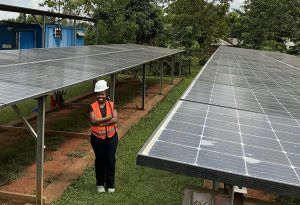
Nirere at a solar-powered mini-grid electrical system run by KUDURA Power in Busia County, Kenya. Her research at UW ECE is helping to inform and establish grid systems like this one, which bring clean, renewable energy to remote communities in Kenya, Tanzania, and Nigeria. Photo provided by Eliane Nirere.
Nirere’s projects in the IDEAS Research Lab have been varied and include collecting data on the adoption of energy-efficient electric kettles in Kigali, Rwanda, and comparing different survey approaches for electrical demand estimation in Fiji. But her main focus as of late has been on helping to bring clean, renewable energy to remote, often rural, communities in Kenya, Tanzania, and Nigeria in the form of solar-powered “mini-grid” electrical systems.
These mini-grid systems are customized to the communities in which they are built. They also operate independently from larger electrical grids that serve cities in Sub-Saharan Africa. In addition to providing clean, affordable electricity to the areas in which they are installed, they have proven to be more reliable than larger electrical grids serving the cities, which can be prone to unpredictable power outages.
“To achieve a transition to renewable energy, we will need decentralized systems, such as mini-grids, to electrify rural areas and also supplement and integrate renewable energies in the larger grids,” she said. “It’s important to note that these systems, which we optimize or develop as engineers, need to be usable and benefit the communities they serve. To achieve that, we need to include the community perspective in our planning.”
Mentorship, community outreach, and looking ahead
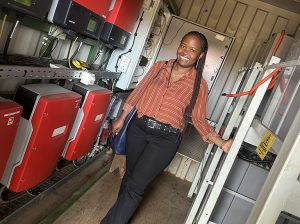
Nirere in the hub of a solar-powered mini-grid system run by Rafiki Power in Kibaigwa, Dodoma, Tanzania. Mini-grid systems like this one are customized to the communities in which they are built. They also operate independently from larger electrical grids that serve cities in Sub-Saharan Africa. Photo provided by Eliane Nirere.
In addition to her work in the IDEAS Research Lab and at UW ECE, Nirere is also a Graduate Fellow with the Clean Energy Institute. In this role, she works with college students in the Washington Mathematics, Engineering, Science Achievement (MESA) program. She helps to teach the students about renewable energy systems through hands-on projects, workshops, and classroom presentations. In addition, she has advised Global Renewables Infrastructure Development (GRID), a UW student organization, on data collection and digitization methods. Nirere said she enjoys her role as a mentor.
“Electricity planning is complicated, and it brings in many different community stakeholders, such as policy makers,” Nirere said. “I’m able to share with students how you can engage with multiple stakeholders, so you can successfully deploy renewable energy systems.”
Looking ahead, one of the results Nirere is aiming to produce from her research is a tool energy developers in Africa could use to better estimate community demand for electricity. She plans to design the tool to make it easy for developers to incorporate community input into their equations. The device will employ sophisticated technologies, such as the machine learning algorithms she uses in her own work.
Nirere said she would like to stay in applied research after completing her doctoral degree, focusing on the transition to renewable energy, decarbonizing electrical grids, and providing better access to electricity for remote areas in Africa and around the world. She noted how the Vadari fellowship is giving her a boost in that direction.
“Receiving this fellowship is gratifying because it shows that there are people who see my work as valuable,” Nirere said. “Being selected means the work I’m doing resonates with them, and it validates that I am contributing to something important. It’s giving me a strong push forward.”
For more information about Eliane Nirere’s work in Africa visit the IDEAS Research Lab website.