

By Wayne Gillam / UW ECE News

UW ECE Assistant Professor June Lukuyu is part of a multi-organization team that has received a Climate Change AI Innovation Grant to develop machine learning datasets, which will enable fast, flexible, and accessible power systems planning in underserved communities in the Global South. Photo by Ryan Hoover / UW ECE
Access to reliable electricity remains out of reach for millions of people across the Global South. At the same time, the worldwide transition to renewable energy is accelerating. Bridging this gap — ensuring that underserved communities can benefit from clean, reliable power — is one of the most important energy challenges today. To help address this issue, researchers are increasingly turning to artificial intelligence, or AI, to design faster, more accessible solutions.
Renewable energy sources, such as solar, wind, and hydropower, are being adopted at growing rates around the world. This shift offers clear benefits, from reducing greenhouse gas emissions to improving public health. But progress is uneven. Wealthier regions with established infrastructure are advancing quickly, while many lower-resource communities face significant barriers to deploying modern energy systems.
These challenges are especially pronounced in the Global South, which includes many countries across Africa, South America, and Asia. Expanding energy access in these regions often means reaching remote or underserved communities — an effort that requires careful planning, coordination, and innovation. With this in mind, governments, industry leaders, and engineers are forming new partnerships to design power systems that are not only sustainable, but also tailored to the specific needs of local communities.
“We’re trying to make power systems planning more accessible to people who are currently left out of the process. Power systems planning is how countries decide what power infrastructure to build, where, and when. It directly shapes whether or not communities get reliable, affordable, and clean electricity.” — UW ECE Assistant Professor June Lukuyu
UW ECE Assistant Professor June Lukuyu is working at the forefront of this effort. A member of the Clean Energy Institute and leader of the Interdisciplinary Energy Analytics for Society, or IDEAS, research group at the UW, Lukuyu focuses on developing sustainable, inclusive, and integrated energy systems for underserved communities. She is also part of a multi-organization team that recently received a Climate Change AI Innovation Grant — an award that supports the use of AI to address critical climate challenges.
The project funded by the award from Climate Change AI is one of just 12 selected from more than 400 applications representing 78 countries, underscoring both its significance and its global relevance. With this support, Lukuyu and her collaborators are developing machine learning datasets that will enable faster, more flexible, and more accessible power systems planning in lower-resource settings.
Why AI matters for energy planning
At the center of this work is machine learning, a branch of AI that allows computers to learn from data and make predictions. In the context of energy systems, machine learning can help planners quickly evaluate different scenarios — reducing the time and expertise required to design effective power networks.
Traditionally, power systems planning relies on complex optimization models that can take days to produce a single scenario and often require specialized technical knowledge. These constraints limit who can participate in planning processes and slow progress, particularly in regions where resources and expertise are limited.
“This grant is supporting work that sits at the intersection of two things that don’t always come together: cutting-edge machine learning research and the practical realities of energy planning in under-resourced contexts,” Lukuyu said. “A lot of sophisticated power systems modeling work never makes it out of the lab, and a lot of planning work in the Global South is constrained by the tools available. We’re trying to close that gap.”
Building smarter, more accessible tools

UW ECE doctoral student Ahana Mukherjee will be developing machine learning models that are optimized for power systems planning in the Global South. The models will be trained on the datasets Lukuyu’s team is curating. Photo courtesy of June Lukuyu.
Lukuyu is collaborating on the project with Mohini Bariya, Joshua Adkins, and Genevieve Flaspohler from Rhiza Research, a nonprofit focused on identifying and addressing gaps in data, technology, and technical capacity in community-centered projects. The partnership combines expertise in power systems planning, machine learning, and applied research, along with strong connections to practitioners in the field.
Also contributing to the work is UW ECE doctoral student Ahana Mukherjee, who is co-advised by Lukuyu and Bariya. Mukherjee will develop machine learning models trained on the datasets the team is curating — datasets designed to serve as the foundation for faster and more user-friendly planning tools.
This effort builds on earlier work by Lukuyu, her IDEAS research group, and members of Rhiza Research. In a previous project funded by Climate Change AI, the team used machine learning to detect and localize power losses caused by malfunctioning equipment and overloaded distribution lines in Ghana. The goal of their approach was to help operators increase efficiency through precisely targeted interventions to address grid failures.
In the new project, the team is expanding that work by focusing on the datasets themselves — an essential building block for effective AI tools.
“The tools that exist today, both open source and commercial, are built on optimization models that can take days to run to come up with one planning scenario,” Lukuyu explained. “They also require significant technical expertise, which excludes many of the planners, researchers, and policymakers who need them most. We want to build something that’s simpler, faster, and computationally light — but still genuinely useful. And the foundation for that is curating a high-quality dataset.”
From research to real-world impact
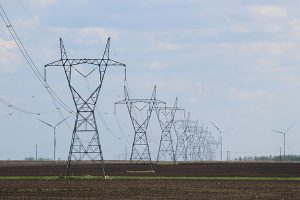
This project builds on earlier work using machine learning to detect and localize power losses from faulty equipment and overloaded power lines in Ghana. The team is now focusing on improving datasets as a foundation for effective AI tools. Photo courtesy of the American Public Power Association.
A key goal of the project is to ensure that these tools are not only developed, but also adopted. Lukuyu emphasizes the importance of collaboration among engineers, governments, nonprofits, utility companies, and energy developers — as well as meaningful input from the communities that these power systems are intended to serve.
Looking ahead, she plans to work closely with universities, practitioners, and community partners in the Global South to share knowledge and build capacity. By integrating these tools into academic and professional settings, the team hopes to expand who can participate in power systems planning.
“The transition to renewable energy needs to be a just transition,” Lukuyu said. “That means people need to be able to participate in the decisions that shape their energy systems. Right now, the complexity of planning tools is a barrier to that participation. If we can lower that barrier, we can open the door to a much broader set of voices.”
By making power systems planning more accessible, Lukuyu and her collaborators aim to help communities design energy systems that reflect their needs and priorities — ensuring that the benefits of the clean energy transition are shared more equitably around the world.
More information about UW ECE Assistant Professor June Lukuyu can be found on her UW ECE bio page and the IDEAS research group website.