

Article by Wayne Gillam, Photos by Ryan Hoover / UW ECE News
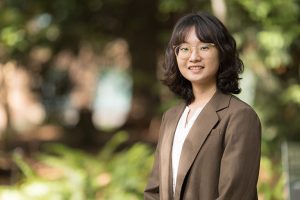
UW ECE Assistant Professor Yiyue Luo is known for her work in intelligent, or “smart,” textiles. At UW ECE, she and her students are expanding this relatively new line of research into developing other forms of intelligent wearable technology.
UW ECE Assistant Professor Yiyue Luo found her professional focus in a surprising way: by choosing to avoid things she didn’t like.
Today, Luo leads the Wearable Intelligence Lab at the UW, where she develops intelligent wearable technologies that can monitor health, improve rehabilitation, and provide robots with a more human-like sense of touch.
“It’s easy for me to realize what I don’t like,” Luo said. “I try not to do what I don’t like, and then that choice tends to move me toward something that is a much better fit.”
This approach to life is reflected in how she first became involved in electrical and computer engineering.
Luo said she was interested in science and engineering from a young age, but in high school, she wasn’t sure which field she wanted to pursue. Her father, a materials scientist, encouraged her to follow in his footsteps.
Taking her father’s advice, Luo enrolled in materials science and engineering at the University of Illinois Urbana-Champaign. As she progressed through the program, however, she discovered that her interests were shifting. Undergraduate research experiences exposed her to electronics design, and she became increasingly drawn toward electrical engineering.
“The sense of touch is a physically grounded modality that humans take for granted. Information from tactile sensing is extremely valuable for many applications, but collecting it remains challenging because the necessary hardware often does not exist. In my lab, we are creating this needed hardware in new form factors that can capture tactile information in a scalable, comprehensive, and continuous way.” — UW ECE Assistant Professor Yiyue Luo
She had already begun participating in materials science research as an undergraduate, but during her sophomore year she decided to change direction and join the Rogers Research Group. This research group was led by Professor John A. Rogers (now at Northwestern University), who was well-known for his interdisciplinary work in materials science, electronics, and bioengineering.
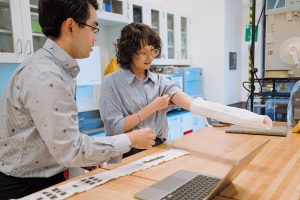
UW ECE postdoctoral scholar and Entrepreneurial Fellow Sen Zhang (left) with Luo in the Wearable Intelligence Lab. Luo is trying on a MultiSensKnit prototype, a sensor-packed knitted sleeve she developed with Zhang that is designed for rehabilitation assessment.
At the time, Rogers was exploring epidermal electronics, ultra-thin, flexible electronic devices that stick to human skin like a temporary tattoo. These devices can monitor physiological signals, serve as highly sensitive electronic interfaces, and even deliver targeted therapies. Luo said she found the research fascinating, and it helped to lay a foundation for her later work.
The experience convinced Luo that the future she wanted to pursue was at the intersection of electronics, computing, and human-centered applications.
After receiving her bachelor’s degree in materials science and engineering, Luo decided to pursue a doctoral degree in electrical engineering and computer science. The transition was unconventional because her undergraduate training was in materials science rather than electrical engineering. But for Luo, the decision felt like a natural progression toward the work that excited her most.
She was accepted into MIT’s EECS program, where she was advised by professors Wojciech Matusik and Tomás Palacios.
It was in Matusik’s Computational Design & Fabrication Group where Luo found her true calling. There, she was introduced to a digital knitting machine that transforms digital designs into knitted fabrics. Matusik and his students used the machine to knit conductive yarn into garments, creating a type of wearable technology known as “intelligent textiles” — fabrics embedded with sensors, actuators, and conductive fibers.
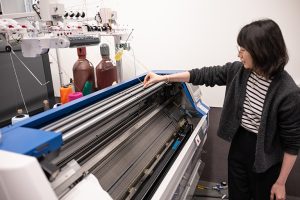
Luo adjusting the digital knitting machine in the Wearable Intelligence Lab. This device transforms digital designs into professional-quality, knitted fabrics.
Intelligent textiles, also known as “smart textiles,” can sense, store, process, and communicate information seamlessly and unobtrusively. They have a wide range of potential applications, including monitoring physiological signals and acting as control interfaces for electronic devices.
As she began working with these textile-based sensing systems, Luo realized that fabric offered a uniquely powerful form factor because of its ubiquity. People wear clothing every day and constantly encounter fabrics through furniture, carpets, and bedding. She also recognized the potential these technologies had to capture tactile information that cameras, microphones, and conventional electronics cannot easily detect.
“With smart textiles, we can sense, monitor, and embed important, physically grounded information, well beyond what images, audio, and text can provide,” Luo said. “This information can be fundamental for understanding human behavior and activity, so I think a lot of opportunities emerge from that.”
While at MIT, Luo produced cutting-edge wearable textile technologies, including digitally embroidered smart gloves that can record, reproduce, and transfer tactile interactions. These gloves can help users learn complex physical hand movements and can enable touch-sensitive robot teleoperation. She also created AI-powered sensing textiles — including vests, socks, and gloves — that can record and monitor a person’s physical interactions with their environment in real time. The technology has a wide range of potential applications in healthcare and robotics. KnitUI, another system she developed, is a machine-knitted user interface that allows users to operate devices through pressure-sensitive fabric.
“I believe students need to experience things hands-on. That’s how I learned, especially as an undergraduate. I feel like I didn’t truly understand research until I actually touched the textile samples and gained a tangible understanding of how things worked. I think this is an important part of my research and my teaching philosophy.” — UW ECE Assistant Professor Yiyue Luo
Luo’s research has been published in leading interdisciplinary journals, such as Nature Electronics, and at top human-computer interaction and robotics conferences. Her work has also been featured in major media outlets and exhibitions.
Her contributions have earned numerous honors, including Best Paper at the 2025 ACM Conference on Human Factors in Computing Systems (CHI) and Best Paper Honorable Mentions at the 2025 ACM Symposium on User Interface Software and Technology (UIST) and CHI 2021. Additional recognitions include the 2025 Sony Faculty Innovation Award, the MIT EECS Jin Au Kong PhD Thesis Award, and selection to Forbes’ 2024 30 under 30 North America list in Science.
By the time she completed her doctorate, Luo had established herself as a rising researcher in wearable intelligence and smart textiles. The next step was building a research program of her own.
After receiving her doctoral degree from MIT, Luo joined UW ECE in September 2024 as an assistant professor.
“UW ECE is special in that it’s technical and rigorous, but it’s also open-minded,” Luo said. “It has faculty with deep fundamental knowledge about electronics, and it provides a supportive, interdisciplinary environment. This all allows me to collaborate on impactful projects that have potential for major contributions to science and technology.”
The Wearable Intelligence Lab
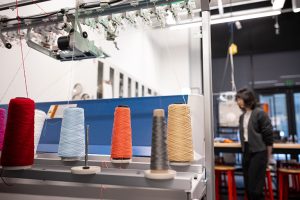
Luo and her students use the digital knitting machine in her lab to knit together traditional yarns (colorful spools) with conductive yarn (gray spool in the foreground), creating fabric that is the basis for different types of intelligent wearable technology.
At the UW, Luo established the Wearable Intelligence Lab to advance the integration of wearable technology and artificial intelligence into end-to-end systems for healthcare, robotics, and human-computer interaction.
Under Luo’s guidance, students in the lab are developing new approaches to tactile sensing and wearable intelligence. UW ECE doctoral student Devin Murphy has developed a smart glove with a sense of touch that could support rehabilitation medicine and help teach robots tactile sensing capabilities. UW ECE doctoral student Hongyu Mao and postdoctoral Entrepreneurial Fellow Sen Zhang are working with Luo to develop MultiSensKnit, a sensor-packed knitted sleeve designed for rehabilitation assessment. Another UW ECE doctoral student, Chankyu (Charlie) Han, has developed MagBall, a magnetic-ball sensor capable of capturing subtle interactions across glass, metal, and human skin. Other lab projects include a glove that teaches the user CPR, machine-knitted magnetoactive textiles that provide sensing and haptic feedback for various applications, and sensorimotor stickies, small patches that can deliver localized, on-body sensing and haptic cues in real time.
“The sense of touch is a physically grounded modality that humans take for granted. Information from tactile sensing is extremely valuable for many applications, but collecting it remains challenging because the necessary hardware often does not exist,” Luo said. “In my lab, we are creating this needed hardware in new form factors that can capture tactile information in a scalable, comprehensive, and continuous way.”
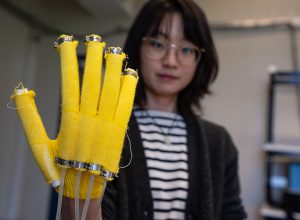
Luo demonstrates a digitally machine-knitted assistive glove, designed to support hand movement.
Luo’s research is interdisciplinary by nature.
At the UW, she collaborates with faculty and students across multiple disciplines to explore new applications for wearable technology and tactile sensing. She is working with UW ECE Professor Chet Moritz, who holds joint appointments in UW Medicine, on rehabilitation technologies, including the MultiSensKnit sleeve she is developing with Zhang. She has also collaborated with UW ECE Associate Professor Sam Burden on equipping robots with human-like sensing capabilities for manipulation tasks and with Siddhartha (Sidd) Srinivasa, a professor in the Paul G. Allen School of Computer Science & Engineering, on human-computer interaction. Beyond engineering and computer science, Luo and UW ECE doctoral student Devin Murphy are brainstorming new tactile-sensing applications with UW Assistant Professor Meichun Liu and her industrial design students. Luo also provides digital knitting machine workshops in the Allen School’s Fabrication Research Lab, helping to introduce students from a variety of disciplines to wearable computing and textile-based technologies.
As an educator, Luo instructs and mentors a mix of undergraduate and graduate students. She said she enjoys teaching and learning from her students as well as watching them develop confidence in their independent thinking. To help facilitate that growth, she encourages students to remain open-minded and pursue experiential learning alongside their academic coursework.
“I believe students need to experience things hands-on,” Luo said. “That’s how I learned, especially as an undergraduate. I feel like I didn’t truly understand research until I actually touched the textile samples and gained a tangible understanding of how things worked. I think this is an important part of my research and my teaching philosophy.”
For more information about UW ECE Assistant Professor Yiyue Luo, visit her bio page and the Wearable Intelligence Lab website.