

Communication and Cybersecurity Pathway
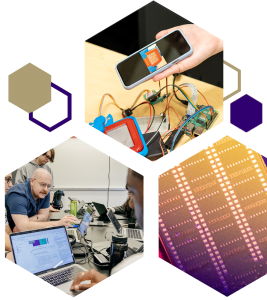
Every text message, video call, and online payment depends on two things working together: a communication system that moves data reliably, and security that keeps that data private and trustworthy. Wireless and wired networks now connect billions of phones, vehicles, satellites, and medical devices, and every new connection is also a potential point of attack. Engineers who understand both how information travels across noisy channels and how networks and devices can be defended are in demand across nearly every industry.
In the Communication and Cybersecurity pathway, students build foundations in random signals, digital and wireless communications, computer networks, cryptography and practical cybersecurity. Students learn how information is transmitted, how various types of networks are designed and analyzed, and how communication systems can be made more secure and resilient, including how machine learning is used to both attack and defend them.
This pathway is a good fit for students who are interested in:
- How technologies like cellular, Wi-Fi, satellite links, and the internet actually work
- Thinking like an adversary to find weaknesses in networks, then designing defenses against them
- A skill set valued across many industries, from telecom and cloud computing to aerospace, health, and government
FAQs
Do I need a graduate degree specializing in this area to be marketable to industry?
No. A bachelor’s degree prepares students well for careers in communications and security engineering, but those who are interested in innovating in next-generation wireless systems or new security technologies, or who are interested in research, should consider a master’s or doctoral degree.
What are some examples of real-world applications?
Cellular, Wi-Fi, Bluetooth, LoRa, Matter networks, satellite internet, secure online banking and shopping, cloud and data center networks, smart homes, connected vehicles, aerial and underwater networks, network defense, secure protocols, and protecting power grids and medical devices from cyberattacks.
Does communication and cybersecurity touch on global impact, equity and/or quality of life?
Yes. Reliable, affordable connectivity expands access to education, health care, and economic opportunity, and strong security protects people’s privacy, finances, and the infrastructure communities depend on. Engineers also have a responsibility to consider how these technologies could be misused and the real-world consequences of system failures or attacks.
Areas of Impact
Communication and security engineering are integral to and drive the real-time operation of the following:
Air and Space
For example, wireless and satellite communication links, secure command and telemetry, resilient aerial networks, secure navigation data
Computing Data and Digital Technologies
For example, designing protocols for cell phones and Wi-Fi, Internet of Things (IoT) applications, data-center communications, and securing cloud services
Environmental Sustainability and Energy
For example, protecting utilities and the smart power grid from cyberattacks and making them more resilient to natural disasters
Health and Medicine
For example, secure wireless links for implantable devices and protecting patient data, reliable, secure connectivity among healthcare systems and connected medical technologies
Infrastructure, Transportation, and Society
For example, telecommunications infrastructure, vehicle-to-vehicle communication, and securing public and private networks
Robotics and Manufacturing
Industrial networking, secure machine-to-machine communication and protection of connected manufacturing systems
Related Career Paths
- Cellular and mobile communication companies: T-Mobile, AT&T, Verizon, Qualcomm, Ericsson, Samsung, Nokia, etc.
- Technology and cloud companies: Microsoft, Amazon, Google, Apple, Meta, Impinj, etc.
- Network and cybersecurity companies: Cisco, F5, Palo Alto Networks, CrowdStrike, etc.
- Aerospace and satellite communications: SpaceX, Boeing, Blue Origin, Amazon Leo, etc.
- Automotive: Ford, GM, Tesla, PACCAR, etc.
- Government and national laboratories: NASA, Pacific Northwest National Laboratory, etc.
On-the-job tasks for graduates with a focus in Communication and Cybersecurity include:
- Designing, testing, and optimizing wireless and wired communication systems, from RF links to network protocols.
- Assessing networks, web applications, and embedded devices for vulnerabilities, and designing defenses against attacks.
- Building machine learning tools that detect intrusions, malware, spam, and other threats.
- Analyzing network architectures and protocols for performance, reliability and security
Communication and Cybersecurity Courses
When planning for courses, review projected course offerings here and be sure to check all course prerequisites (course titles below link to the catalog course description, which includes prerequisite information).
These courses are suggested for those following the Communication and Cybersecurity pathway but are not required to complete the BSECE degree program:
EE 416 – Random Signals for Communications and Signal Processing
Real communication systems must work in the presence of noise and uncertainty. This course introduces the probability and random-process tools used to model those effects and to design statistical filters for detection and estimation.
EE 417 – Modern Wireless Communications
Learn how digital data is sent reliably over the air. Topics include modulation, optimum receiver design, error-control coding, multipath fading, and RF link budget analysis, with applications to Wi-Fi and other wireless networks.
EE 418 – Network Security and Cryptography
Introduces the fundamental tools of cryptography and the protocols that apply them to secure networks and communications.
EE 419 — Introduction to Computer-Communication Networks
How does the internet actually work? This course covers network architectures and protocol layers, including switching, multiple access, routing, congestion and flow control, and transport protocols, along with an introduction to network security.
EE 467 – Machine Learning for Cybersecurity
A hands-on course applying machine learning to security problems such as anomaly detection, spam detection, and IP blacklisting. Students also learn how deep neural networks themselves can be attacked through adversarial inputs and hidden backdoor triggers.
Capstone
EE 497 (winter quarter) and EE 498 (spring quarter) — Engineering Entrepreneurial Capstone (ENGINE)
The Engineering Entrepreneurial Capstone program (ENGINE) is the culmination of a student’s electrical and computer engineering education at UW ECE. The program provides a unique opportunity for students to develop skills in collaborative systems engineering, project management, and most importantly, working in teams on real-world problems from industry-sponsored projects. The program is overseen by UW ECE faculty and students are guided by practicing engineers. The course culminates in a showcase of student projects, which is attended by industry sponsors and held at the end of spring quarter every year.
Crossing Paths
Students studying Communication and Cybersecurity consider also consider the following pathways:
Enriching Your Path
The following courses are also recommended:
EE 361 – Applied Electromagnetics