

By Wayne Gillam / UW ECE News
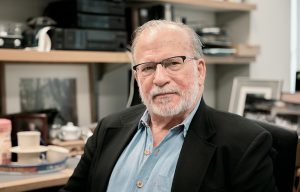
UW ECE Professor Emeritus Les Atlas at his on-campus office in August 2025. Photo by Ryan Hoover / UW ECE
Last spring, UW ECE Professor Emeritus Les Atlas unexpectedly passed away. Over his career, Atlas helped shape fields ranging from digital signal processing to machine learning, mentored generations of students and researchers, and co-developed the world’s first portable cochlear implant speech processor. He had been a professor in the Department for over 41 years, with an adjunct appointment in the Paul G. Allen School of Computer Science & Engineering.
After retiring in July 2025, Atlas remained active in UW ECE as a professor emeritus for as long as his health allowed. During his tenure, he made many important contributions to the Department while producing groundbreaking research in machine learning and digital signal processing. He left behind a legacy of curiosity, innovation, and mentorship that continues through the many students, colleagues, and collaborators whose lives he influenced.
“Les took on many different leadership and service roles at UW ECE over the years, and his contributions were invaluable to the growth and development of our Department,” said UW ECE Professor and Chair Eric Klavins. “He also was a leader in his chosen field. His research, teaching, and mentorship impacted generations of students and researchers here at the UW and around the world.”
Atlas started his career at UW ECE in 1984 as an assistant professor, shortly after receiving his doctoral degree in electrical engineering from Stanford University. At Stanford, he was part of a research team that developed the world’s first portable, real-time speech processor for a cochlear implant. This speech processor is now part of the permanent collection of the Computer History Museum in Mountain View, California.
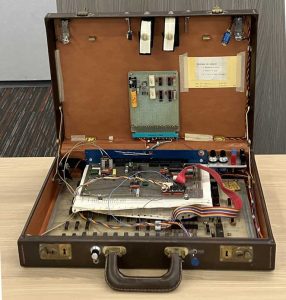
The Stanford PSP-2 Portable Speech Processor, an early prototype of the world’s first portable, real-time speech processor for a cochlear implant. Atlas was part of a Stanford University graduate student research team that engineered this device in the 1980s. This speech processor is now part of the permanent collection of the Computer History Museum in Mountain View, California. Photo from the Computer History Museum.
After joining UW ECE, Atlas began building on this research and drew inspiration from biological systems to help create the next generation of electronics. In 1987, he was part of a research collaboration that replaced simple multiplication operations in an artificial neural network with a “convolution” operation. An artificial neural network is a computational model inspired by the structure and function of the human brain. Artificial neural networks are a foundational component of many modern artificial intelligence systems.
In the convolution-based approach that Atlas and his colleagues introduced, each network connection acts as a filter applied across time, rather than a single, fixed value. This approach, initially applied to speech sounds, contributed to what is now known as a “convolutional neural network,” or CNN — a type of deep learning artificial neural network commonly used to analyze audio and visual data, such as sounds, images, and videos.
Today, convolutional neural networks are integral to computer vision, speech and audio recognition, autonomous systems, and many other artificial intelligence applications. Atlas and his colleagues introduced the term “convolution” for this kind of network, helping establish concepts that contributed to the broader development of modern artificial intelligence.
“Les took on many different leadership and service roles at UW ECE over the years, and his contributions were invaluable to the growth and development of our Department. He also was a leader in his chosen field. His research, teaching, and mentorship impacted generations of students and researchers here at the UW and around the world.”
— UW ECE Professor and Chair Eric Klavins
In the late 1980s and early 1990s, Atlas collaborated with UW alumnus David (Pablo) Cohn (Ph.D. ‘92) and Professor (now Emeritus) Richard Ladner in the Allen School. The trio were early trailblazers in machine learning and artificial intelligence. Together, they introduced now-standard concepts in machine learning, such as “selective sampling” and “active learning.” These concepts offered new ways for artificial neural networks to cope with limited data.

Atlas (center) alongside UW alumnus David Pablo Cohn (left) and Allen School Professor Emeritus Richard Ladner (right) at Atlas’ May 2025 UW ECE Research Colloquium. In the late 1980s and early 1990s, Atlas, Cohn, and Ladner were early trailblazers in machine learning and artificial intelligence. The trio introduced new ways for artificial neural networks to cope with limited training data. Photo provided by David Pablo Cohn.
“Les was a very kind and generous person, especially with students,” Ladner said. “He was liberal with sharing ideas that would help students progress toward their degrees. I saw this first-hand with my student Pablo.”
“What I remember best about Les is the joy he took in being a colleague and mentor when he was part of a collaboration or a project, or teaching a class, or really, anything bigger than himself,” Cohn said. “The delight he took in brainstorming with anyone was palpable. He’d just as happily sit down with a brand-new student as with a shining star in his field, or any other field, or even better, all three at once, to hash out ideas and explore unexpected connections.”
Atlas was a leader in signal processing research and educational activity in the Pacific Northwest. He held many leadership roles in the Department and in the field of electrical and computer engineering, such as co-chairing the 1998 Institute of Electrical and Electronics Engineers (IEEE) International Conference on Acoustics, Speech, and Signal Processing.
Atlas’s influence can also be seen through the accomplishments of his former students, who have secured faculty positions at leading universities, launched Google’s first machine learning seminar, received multiple Technical Emmy Awards, and founded companies such as Redfin.

Atlas (far right) with (from left to right) Amil Khanzada and Reina Saito from Virufy, Oleg Zaslavsky from the UW School of Nursing, and Nicholas Rasmussen from Virufy. Photo by Amil Khanzada.
Atlas continued in a mentorship role as a professor emeritus, advising graduate students, alumni, and those embarking on new careers or entrepreneurial endeavors. Because of his dedication to mentorship and foundational research, researchers, students, and entrepreneurs continue to build upon his work in machine learning and artificial intelligence.
His commitment to mentorship continued after his retirement. One recent example was his work with Amil Khanzada and his colleagues at Virufy, a nonprofit startup developing artificial intelligence that analyzes cough and breathing sounds to screen for respiratory conditions. Khanzada, who founded Virufy, recently received his doctoral degree in engineering from the University of Fukui, Japan, where he is a specially appointed assistant professor. He reached out to Atlas in 2021, seeking an expert collaborator for the startup. The two hit it off, and Atlas later became Chief Technology Officer for Virufy, playing a key advisory role in the company.
“Les was a very kind and generous person, especially with students. He was liberal with sharing ideas that would help students progress toward their degrees.” — Allen School Professor Emeritus Richard Ladner

In his spare time, Atlas was an avid biker, often seen around campus with a helmet under his arm and a bike in tow. Photo provided by Janet Atlas.
“Professor Atlas played a pivotal role in the development of Virufy, not only providing me with a UW affiliation as a research collaborator but also co-developing the underlying patented acoustic AI technology for our venture and helping us win grants jointly to push forward our nonprofit mission,” Khanzada said. “He was always very generous with his ideas and credit in a field where that is not universal, and he brought me into work documenting the history of convolutional neural networks that I am still carrying on today.”
“Professor Atlas was both a mentor and a friend. He advocated for my career in ways I am still discovering, and he consistently created space for my ideas to grow,” added Nicholas Rasmussen, a doctoral student at the University of South Dakota, pro tem researcher in UW Medicine, and lead artificial intelligence model engineer for Virufy. “Working with him was a privilege, and learning from him shaped the trajectory of my professional life.”
By all accounts, Atlas very much enjoyed these sorts of collaborations, and he thought highly of people at UW ECE. Not long after being appointed a professor emeritus, he was asked about the years he spent in the Department.
“My time at UW ECE has been life-changing,” Atlas said. “The academic environment here is accepting of ideas outside of the mainstream, and the quality of the students, faculty, and staff is outstanding.”
Atlas was recognized for his own outstanding work with numerous awards and honors throughout his career, including a National Science Foundation Presidential Young Investigator Award, which was signed by President Ronald Reagan. He was a Life Fellow of IEEE, a Senior Fulbright Scholar, and a Virginia Merrill Bloedel Scholar. His work was also funded by many other businesses and organizations, including the Office of Naval Research, the Army Research Office, and the Wallace H. Coulter Foundation.
For the students, colleagues, and collaborators whose lives he touched, Atlas’s time at UW ECE was life-changing as well. His contributions to research, education, and mentorship continue to shape the Department, the field, and the people who had the privilege of learning from him.
Learn more about Professor Emeritus Les Atlas and his time at UW ECE in this retrospective piece:
“A distinguished career, marked by contributions to machine learning research and education.”
Condolences to the family can be sent to UW ECE Academic HR Specialist Mickey Schulz at ahr@ece.uw.edu.